
History & Civics
With reference to the Lucknow Pact, answer the following questions:
(a) Mention any three factors that led to the signing of the Lucknow Pact in 1916.
(b) Mention any three clauses of the Pact.
(c) Why was the signing of the Lucknow Pact an important event towards the growth of unity in India?
Muslim League
78 Likes
Answer
(a) Three factors that led to the signing of the Lucknow Pact in 1916 were-
- National Events — There were important national events that changed the attitude of the Muslim League.
- Firstly, the Partition of Bengal was cancelled.
- Secondly, nationalist Muslims like Abul Kalam Azad and the All Brothers - Maulana Mohammad Ali and Shaukat Ali — made use of this opportunity to spread nationalist ideas among the Muslims for mobilising public opinion in favour of self-government.
- Thirdly, Tilak was released from jail in 1914, after six years.
- Finally, under the 'Seditious Meetings Act,' some prominent Muslim leaders were arrested. This brought the Muslim League and the Congress closer.
- Changes in the Objectives of the Muslim League — In the beginning the League had support for the British Government as one of its objectives.
- In 1913, the League had amended its Constitution to include, 'a system of self-government under the aegis of the British Crown' as the ideal of the Muslim League. Therefore, it agreed with the Congress to have a political goal for India.
- The unity of interests and objectives opened the doors for renewed cooperation between the Congress and the Muslim League.
- Annie Besant and Bal Gangadhar Tilak too played a significant role in bringing the two organisations together.
- A Compromise Between the Two Factions of the Congress — Annie Besant tried to reunite the two wings of the Congress — the Early Nationalists and the Assertive Nationalists. Tilak rejoined the Congress in 1916 and played a major role in resolving differences between the Congress and the League.
(b) Three clauses of the Lucknow Pact are as follows-
- Abolition of the India Council — The India Council of the Secretary of State, operating from England, should be abolished. The Secretary of State for India was to be assisted by two Under-Secretaries, of whom one should be an Indian.
- Minorities in Elected Bodies — The minorities should have adequate separate representation in elected bodies.
- Limitation of the Imperial Legislature — Defence, foreign affairs and political relations of India, i.e., declaration of war, or signing of peace treaties, were excluded from the control of the Imperial Legislature.
(c) The signing of the Lucknow Pact was an important event towards the growth of unity in India because of the following reasons-
- Hindu-Muslim Unity — The joint scheme symbolised Hindu-Muslim unity. Both the communities agreed to compromise in some areas for the common good. The Congress compromised on its secular character by accepting the scheme of separate electorates for Muslims. The Muslim League accepted the principles of election and the majority rule. As a result of this pact, the Hindus and the Muslims worked together from 1916 to 1922.
- Unity Within the Congress — The Lucknow Session and the signing of the Lucknow Pact brought about unity between the Assertive Nationalists and the Early Nationalists. After the Surat Session of 1907, both wings of the Congress were moving in different directions. They came together in 1916 and as a result, the Congress was strengthened.
Answered By
55 Likes
Related Questions
(a) Identify the persons in the given picture. Which agreement for a joint scheme of political reforms was signed by these two persons? The agreement was signed post which international event?
(b) Mention any three factors that led to the signing of this agreement.
(c) State any two significant outcomes of this agreement.
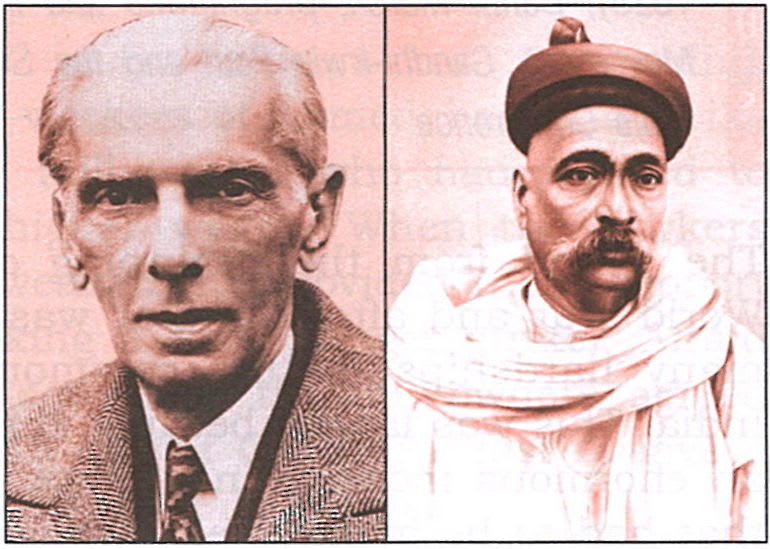
Realising the aims and objectives of the Muslim League when it was formed in 1906, do you think that more than the Muslim League, it was the British policy of Divide and Rule, that encouraged the communal forces to create a rift between the two communities in India.
Mahatma Gandhi said, "Communal harmony could not be permanently established in our country so long as highly distorted versions of history were taught in her schools." State your views on this statement and justify it by giving examples.
Not many people are aware of the friendship built on mutual respect that was a symbol of Hindu-Muslim unity of India—the friendship between Lokmanya Tilak and Mohammed Ali Jinnah. When Tilak, as the President of Home Rule League, was leaving for England to press for India’s demand for Swaraj, Jinnah had proclaimed that there was no man more fitted to voice the opinions of Indians other than Tilak who had devoted his whole life to the cause of his country. Trace the events that led to Jinnah demanding Partition of the country and the establishment of Pakistan. The relationship between the two countries till date is a proof of the discord sowed by the British. What in your opinion, can be done to improve relations between the two countries.