
Mathematics
The fourth vertex of a parallelogram ABCD, where A = (3, -2), B = (7, 6) and C = (3, 8) is :
D = (1, 0)
D = (-1, 0)
D = (0, 1)
D = (0, -1)
Section Formula
7 Likes
Answer
Let co-ordinates of D be (x, y).
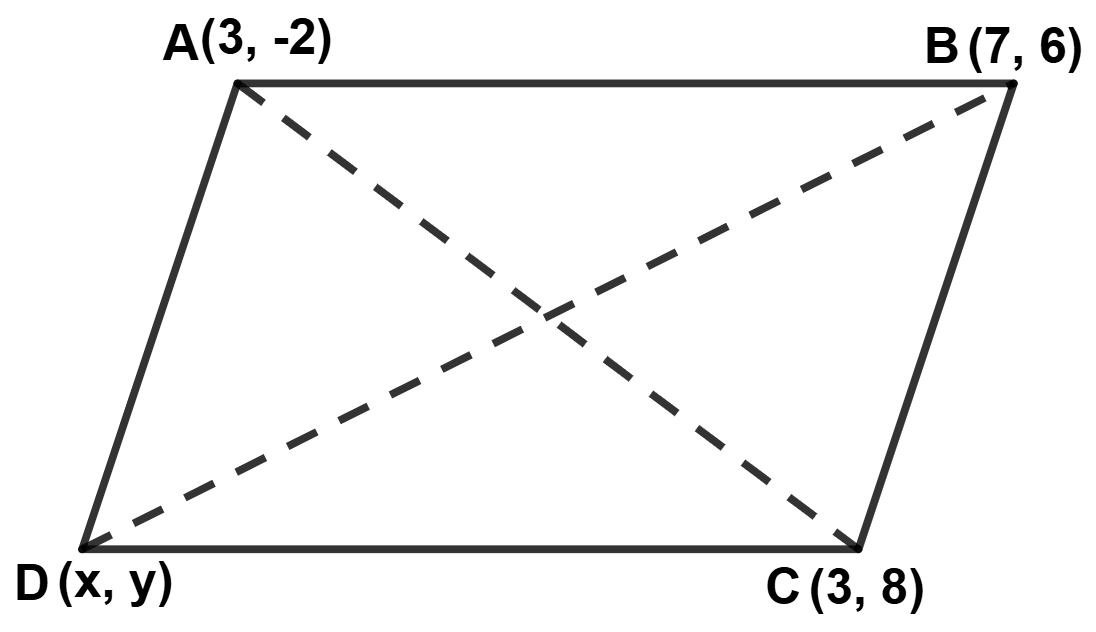
We know that,
Diagonals of parallelogram bisect each other.
∴ Mid-point of AC = Mid-point of BD.
D = (x, y) = (-1, 0).
Hence, Option 2 is the correct option.
Answered By
3 Likes
Related Questions
If matrix , then :
a = 4 = b
a = 2 and b = 6
a = 1 and b = 7
a = 3 and b = 5
On simplifying the expression , we get :
sec2 θ + tan θ
sec2 θ - tan θ
sec θ + tan2 θ
sec θ - tan2 θ
The total invoice value of a toy, in intra-state transaction is ₹ 5,600. Rate of GST is 12%. Then SGST for this toy is :
₹ 300
₹ 600
₹ Nil
₹ 313.60
For any real value of k, the roots of the quadratic equation x2 + kx - 9 = 0 are :
real and equal
imaginary
real and unequal
none of these